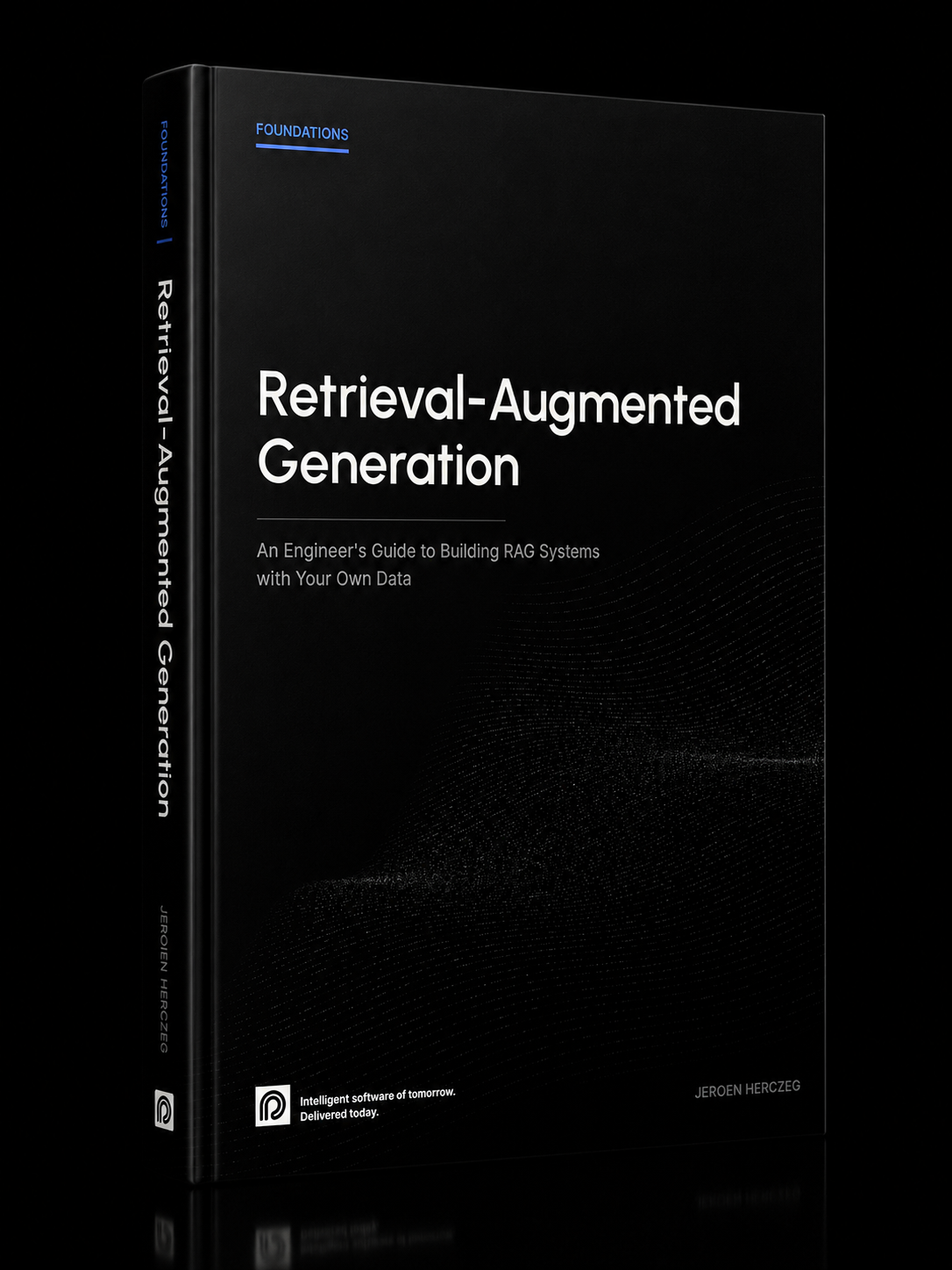
A practical engineering book for building retrieval-augmented generation systems with your own data, from the first prototype to production patterns like evaluation, observability, and agentic RAG.
Most teams trying to ship a RAG system stall at the prototype stage. The notebook works, the demo wins the meeting, the system never reaches users at scale. The gap between “this works on my laptop” and “this runs reliably in production” is wide, and full of engineering challenges that don't make the demo reel. This book is about that gap.
The book
For engineers who need to ship something real
This book is written for engineers, not researchers writing benchmarks or managers picking vendors. For the person at the keyboard who needs to make decisions about chunking strategy, vector store choice, evaluation methodology, and production operations, and who's tired of vendor-shaped blog posts and tutorials that stop at the prototype.
Each chapter pairs concept with implementation. Real code on a real corpus, runnable end to end. The seven failure points of a RAG pipeline are introduced in chapter 1 and traced through every subsequent chapter, so you learn to recognize where things break, not just patch them when they do.
By the end you'll be able to
Choose a chunking strategy on retrieval evidence, not intuition.
Pick FAISS, pgvector, or Qdrant based on your actual constraints.
Build a RAG pipeline that handles real PDFs with OCR artifacts, encoding issues, and dirty markdown.
Evaluate retrieval quality separately from generation quality, and prove your changes help.
Add reranking, hybrid search, and query transformation when (and only when) they earn it.
Catch the seven failure points before they reach production.
Scale, monitor, and cost-optimize a RAG system that survives a deploy.
Every chapter builds on a single running example with real code you can clone and run.
Table of contents
13 chapters. 268 pages. From foundations to production to agentic RAG.
Every chapter builds on a single running example, the Acme Corp knowledge base, with real code you can clone and run.
p. 1
The Problem RAG Solves
What an LLM can and cannot do
Limitations of a standalone LLM
The RAG mental model
The RAG pipeline end-to-end
RAG vs. fine-tuning vs. long-context prompting
The seven failure points
Standalone LLM vs. RAG demo
p. 20
Embeddings
From words to vectors
The bi-encoder architecture
Generating embeddings locally and via API
Cosine similarity and distance metrics
Visualizing embedding space with UMAP
Choosing an embedding model
Similarity search from scratch
p. 43
Chunking Strategies
The chunk size tradeoff
Fixed-size chunking
Recursive character splitting
Semantic chunking
Document-structure-aware chunking
Contextual chunking
Comparing strategies: a retrieval test
p. 61
Vector Storage and Indexing
Exact vs. approximate nearest neighbor
The speed-accuracy-memory tradeoff
How HNSW works
FAISS, pgvector, and Qdrant
Tuning index parameters
The comparison benchmark
p. 90
Building the Ingestion Pipeline
The ingestion flow
Parsing real-world documents
Text cleaning and normalization
The full pipeline: parse, clean, chunk, embed, store
Metadata extraction and storage
Idempotent re-ingestion
p. 115
Hybrid Retrieval
Keyword retrieval and the BM25 mental model
Adding a search vector to the chunks table
Where each retriever fails the other's queries
Hybrid retrieval as candidate generation
Filters as candidate-set scoping
p. 135
Your First RAG Pipeline
Selecting context from the candidate pool
Building the prompt
The complete pipeline
Where the pipeline succeeds and fails
The failure catalog
p. 152
Reranking
Why first-stage retrieval optimizes for recall
Bi-encoder versus cross-encoder
Adding a local reranker (bge-reranker-v2-m3)
Choosing K and N
Latency and the cost of cross-encoders
When reranking is not worth it
p. 172
Query Transformation
Where query transformation belongs
Query rewriting
HyDE: search with a hypothetical answer
Multi-query expansion
Decomposition
When transformation hurts
p. 188
Evaluating RAG Systems
Two evaluation surfaces
Building an evaluation set
Retrieval metrics
Generation metrics
The ablation table
Regression tracking
p. 205
Hardening for Production
Stage-level observability
Tracing across stages
Failure modes and graceful degradation
Configuration and secrets
Model versioning and the silent-rebuild trap
Security boundaries in RAG systems
Deploying changes safely
p. 226
Advanced Retrieval Patterns
Parent-document retrieval
Contextual retrieval
Graph-based retrieval
ColBERT and late interaction
The complexity test
p. 244
Agentic RAG
Retrieval as a tool call
Multi-step reasoning loops
Bounding agentic loops
Observability for agents
When agentic RAG is worth it
Running example
One corpus. 13 chapters. Real code you can run.
Every chapter operates on a single running example: the Acme Corp knowledge base, a fictional 500-employee SaaS company with 110 internal documents across HR, IT, operations, compliance, product, and engineering. The corpus is engineered to surface every failure mode the book teaches.
Stop shipping RAG demos that break in production.
Learn how to build retrieval systems you can test, debug, measure, and improve.
Jeroen Herczeg is a senior software engineer who builds AI systems for production. Twenty years of engineering experience, now applied to AI agent orchestration and retrieval-augmented generation.
Most recently he built the AI agents demo for Google and BBC, which won the Broadcast Tech Innovation Award. He started studying AI seriously in 2017 with Udacity's Artificial Intelligence Nanodegree, well before the current wave of large language models.
He writes about practical AI engineering at herczeg.be/blog and lives in Belgium. This book exists because most of what he learned shipping production AI is locked in private codebases, and someone should write it down.